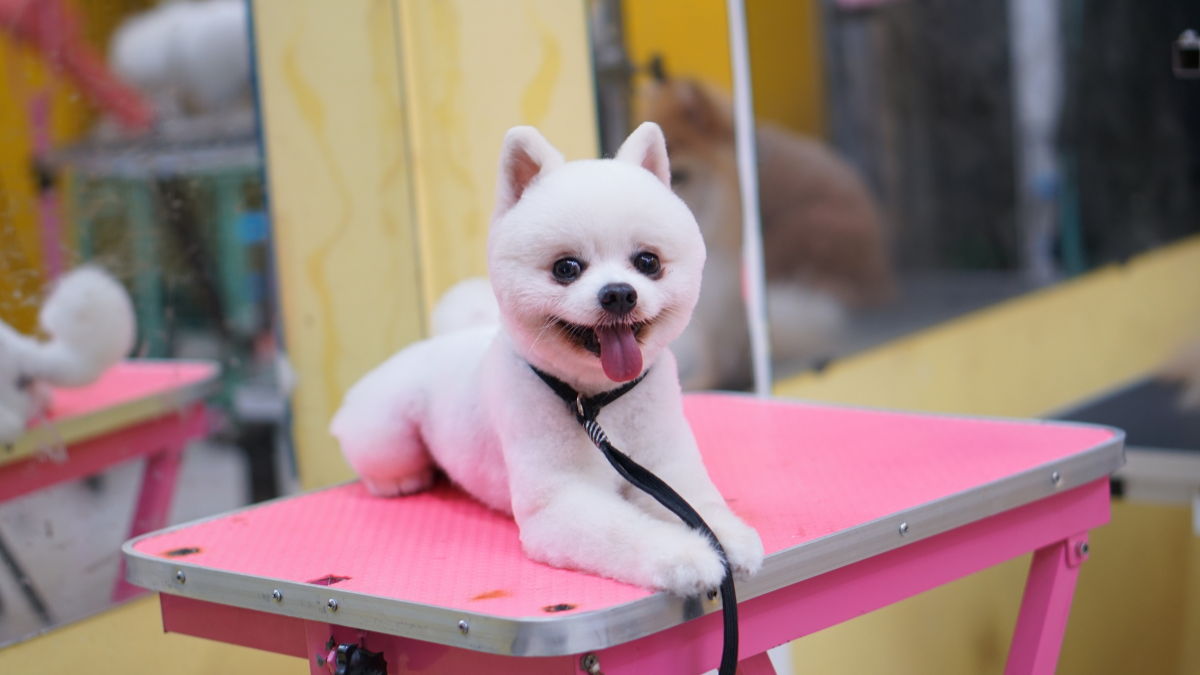
Pomeranian grooming advice written for cooler climates will get you into trouble in Singapore. The breed has a thick double coat designed for northern winters. Singapore has 80% humidity year-round and temperatures above 30°C. That mismatch changes everything about how you care for the coat, how often you book a groomer, and what you absolutely should not let anyone do with a pair of clippers.
Pomeranians are one of the most popular small breeds in Singapore. They fit HDB regulations, they have big personalities for a 3kg dog, and they look spectacular when properly groomed. But that coat takes real work here. This is the guide.
Understand the Double Coat First
Your Pomeranian has two layers of fur doing two different jobs.
The guard coat is the long, coarse hair on the outside. It repels water, blocks UV rays, and gives the Pom its shape. Underneath sits the undercoat, a dense, soft layer that traps a thin cushion of air against the skin. That air pocket works as insulation. In winter, it keeps warmth in. In Singapore's heat, it keeps cool air close to the body and prevents the sun from reaching the skin directly.
Both layers grow on independent cycles. The guard coat grows slowly. The undercoat sheds and regenerates faster. When you clip or shave a Pom, the undercoat races back while the guard hairs lag behind. The result is a coat that feels cottony, looks patchy, and does not insulate properly in either direction.
Never Shave a Pomeranian
This is the single most important thing in this guide.
Shaving does not cool a Pomeranian down. It removes the layer that keeps cool air in and UV rays out.
When a Pom is shaved, three problems follow. First, the coat texture changes. The undercoat grows back faster than the guard hairs, crowding them out. The coat comes back fuzzy, uneven, or a completely different colour. Second, recovery is slow. Some Pomeranians show no visible regrowth for months. Full restoration can take 6 to 24 months, and older dogs may never recover fully. Third, there is a breed-specific risk called post-clipping alopecia, where the hair cycle stalls entirely. The dog is left with bare patches on its trunk while the head and legs stay normal.
The only time shaving is acceptable: a surgical requirement, or a last-resort intervention for severe matting so bad it cannot be brushed out.
What About Popular Grooming Styles?
The teddy bear cut and lion cut look cute on Instagram. Both involve clipping the body coat short, and both carry the same risks as a full shave. Any style that requires a clipper on the body coat can trigger uneven regrowth or alopecia.
The safest approach is a show trim: the full coat stays intact, with scissors used only to tidy the feet, ear tips, sanitary area, and any straggly outer hairs. Your Pom keeps its fluff, its insulation, and its protection. Ask your groomer for a "neaten, don't shorten" approach.
Grooming Schedule for Singapore
Standard advice says every 4 to 6 weeks. In Singapore, book every 3 to 4 weeks. The humidity accelerates matting, and the undercoat packs flat faster in warm, moist air. Waiting 6 weeks here is like waiting 10 weeks in London.
| Task | Frequency (Singapore) | Standard (Temperate) |
|---|---|---|
| Professional groom | Every 3 to 4 weeks | Every 4 to 6 weeks |
| Brushing at home | 3 to 4 times a week | 2 times a week |
| Bathing | Every 2 to 3 weeks | Once a month |
| Nail trim | Every 3 to 4 weeks | Monthly |
| Ear check | Weekly | Monthly |
For a broader look at grooming schedules across breeds, see our breed-by-breed grooming frequency guide.
What to Do Between Grooms
A Pom that shows up matted costs more and takes longer. What you do at home between appointments determines the condition of the coat and the size of the bill.
Brushing
Three to four times a week, minimum. During heavy shedding periods, go daily. Use a slicker brush first to catch surface tangles, then follow with an undercoat rake to pull out loose fur from underneath.
The technique matters. Work in sections, brushing upward and forward from the skin outward. This is called line brushing. It lifts the undercoat and removes dead hair before it packs down against the skin. Surface-only brushing looks tidy but misses the mats forming underneath, right where moisture sits.
Matting Hotspots
Check these areas every time you brush:
- Behind the ears. Fine hair that tangles fast.
- Armpits. Friction from walking creates knots within days.
- Back of the hind legs. Especially where the leg meets the body.
- The groin and rear area, where moisture from the ground collects.
If you find a mat, do not pull it. Hold the base of the mat against the skin with your fingers and work through it from the tip with a steel comb. Pulling a mat rips the skin and teaches your dog to dread grooming sessions.
Bathing and Drying
Bath every 2 to 3 weeks. More often strips the natural oils. Less often in Singapore means bacteria and odour build up in the undercoat.
The step most owners skip is drying completely. Towel-drying a Pom is not enough. The undercoat holds moisture for hours. In 80% humidity, it may never fully air-dry. Use a blow dryer on a cool or warm setting and dry all the way to the skin. Pay attention to the armpits, groin, between the toes, and behind the ears. These are the spots where fungal infections start.
Singapore's Humidity and Skin Risks
The Pom's undercoat is dense enough to trap moisture against the skin even after a short walk. In Singapore, this creates conditions for problems that dog owners in drier countries rarely deal with.
- Hot spots. Inflamed, painful patches that can appear within 48 hours. They start small and spread fast when the coat stays damp. VCA notes that matted fur trapping water is one of the primary triggers.
- Yeast infections. Warm, moist skin folds and ears are breeding grounds. You will notice a musty smell, redness, or dark waxy buildup in the ears before it gets visible on the coat.
- Alopecia X. Pomeranians are specifically prone to this condition where guard hairs fall out, leaving bare patches on the trunk. The cause is not fully understood, but coat stress from matting, improper grooming, or clipping is believed to be a contributing factor.
Regular brushing is the cheapest prevention for all three. It keeps air circulating through the coat and stops moisture from sitting against the skin.
The Puppy Uglies
If your Pom is between 3 and 10 months old and looks patchy, scraggly, or nothing like the fluffy ball you expected, that is normal. It is called the puppy uglies.
Pomeranian puppies are born with a single-layer coat. Around 3 to 4 months, this coat sheds while the adult double coat grows in underneath. The two layers shed and grow at different rates, so for a few months the dog looks uneven. Some puppies barely show it. Others look genuinely rough.
The adult coat can take 18 months to 3 years to reach full density. During the puppy uglies, do not clip the coat short. Clipping disrupts the new guard hairs before they have a chance to establish their growth cycle. Brush gently and frequently, and wait it out.
What Pomeranian Grooming Costs in Singapore
A full Pom groom runs S$90 to S$140 per session. That is higher than Maltese or Shih Tzu (S$75 to S$120) because the double coat takes longer to brush out, de-shed, and blow-dry thoroughly.
| Service | Cost |
|---|---|
| Full groom (salon) | S$90 to S$140 |
| Full groom (mobile) | S$120 to S$180 |
| De-shedding add-on | S$20 to S$50 |
| De-matting surcharge | S$25 to S$50 |
| Medicated bath | S$10 to S$30 |
At every 3 to 4 weeks, the annual cost comes to roughly S$1,000 to S$1,800. That sounds steep until you compare it to a single vet visit for a skin infection (S$100 to S$300) or a full de-mat session on a neglected coat (S$150 or more).
For a broader breakdown of grooming prices across all breed sizes, see our dog grooming prices guide.
Common Mistakes Pom Owners Make
- Using the wrong brush. A bristle brush looks right but cannot reach the undercoat. You need a slicker brush and an undercoat rake. The pin length on the rake should match your Pom's coat depth.
- Bathing with human shampoo. Dogs have a different skin pH. Human products strip the coat and irritate the skin. Use a shampoo formulated for dogs.
- Skipping paw pad trims. Hair grows between the paw pads and traps dirt, moisture, and debris. In Singapore's wet weather, untrimmed pads stay damp and become a hotspot for bacterial growth.
- Over-bathing. More than once every two weeks strips the natural oils that keep the coat water-resistant and healthy. If your Pom smells between baths, the issue is likely the undercoat retaining moisture, and the fix is better drying and more frequent brushing.
If you are unsure whether your groomer is handling your Pom's coat correctly, read our guide on how to find a groomer who actually knows your breed.